Learn about how the roman viewed their conquered provinces. Were all foreigners barbarians? Find out below!
Rome and ‘Barbarians’, foes or friends?
Introduction
The imperial period commenced during the reign of Caesar. However, by the reign of Augustus, Rome had already seized control of the Mediterranean. Romans did not perceive the people of these annexed provinces as their equals, often using the term ‘barbarian’(barbarous) to describe them. The image of the barbarian was widespread in Rome’s art, iconography and historical writing, fast becoming the symbolic anthesis of the glory and power of the Roman Empire. Thus, foreign provinces were arguably never going to be adopted by the Romans as one of their own. Despite this, many provinces learnt to accept the Roman rule within their own culture’s art style. Furthermore, there appears to be a direct correlation between a province’s assimilation to Roman culture and the respect afforded to said province in Roman writing.
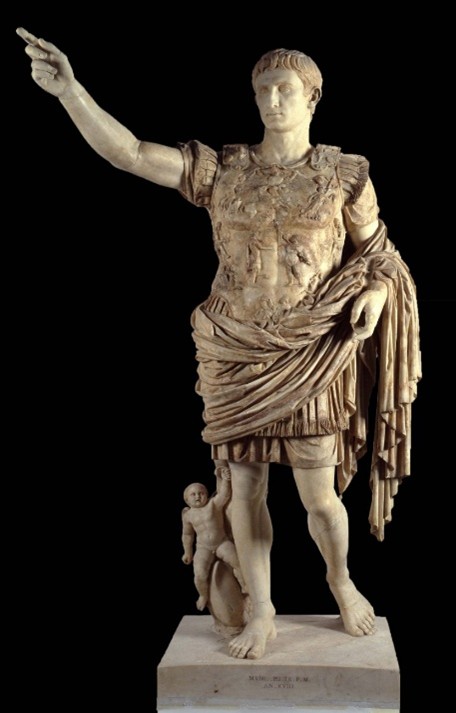
Vatican Museum 2025, Artefact File: Cat.2290
The Roman ‘barbarian’ was a vital cultural figure who’s perceived flaws served to elevate the superiority of Rome.’ Woolf states during the imperial period there was a growing belief among Romans that they were ordained by the gods to rule and claim dominion of the East. Throughout the imperial period propaganda imagery of barbarians being conquered by the Roman emperor/army littered arches, coinage, imperial portraiture etc. The rise of the authoritarian rule demanded a counterpart to Rome’s excellence to justify its control over not only the East but its own people. Thus, the uncivilized ‘barbarian’; was used to highlight Rome’s own Virtus, glory and superiority. This phenomenon is exhibited in the conflict between the Parthians and Romans. Although Rome initially failed to take Parthia, Schneider claims that when they eventually triumphed this success was championed as the West’s victory over the ‘Barbarian East.’ One of the more powerful images which was created in celebration of this victory was the cuirassed statue of Augustus from Prima Porta (Figure 1). Augustus’ armor features Rome defeating Parthia both who are depicted as equal but polar opposites, one cultured, one uncivilised and thus the viewer is encouraged to perceive Rome’s victory as the restoration of the natural order. Roman iconography continually utilized the image of barbarians to highlight the mightiness of Rome itself. The common example is the depiction of ‘barbarians’ kneeling at the feet of their conqueror. This use of imagery perpetuates the idea of a social hierarchy in which Rome consistently reigns superior. Thus, one could argue that those populations which Rome considered to be ‘barbarians’ would never be fully accepted as they served a perfunctory purpose as the anthesis of Rome’s success. However, it is important to acknowledge the expectations that Roman writers and artists would produce works to appease the emperor, or face possibly deadly consequences. For instance, Tiberius was one of many emperors to dispose of his critics when he executed Saturninus and Paconianus on the grounds that they had attacked him in their verse.
Throughout the imperial period eastern provinces created various pieces of art to honour the Roman emperor, demonstrating some degree of the cultural assimilation. However, the unique differences in these artworks reveal that despite being under Roman rule these provinces still managed to maintain parts of their ethnic identity. For example, Figure 2 depicts a terracotta statue from Egypt which illustrates a Roman emperor garbed in a classic Roman military tunic and armor pulling a kneeled captive by the hair. Firstly, it must be noted that this image is praising the emperor, implying at the very least a tolerance of the Roman rule. However, the imagery of dragging a conquest by the hair was not found in Roman works. This visual was primarily featured in pharaonic Egypt, often used in depictions of pharaohs or gods. A second example is seen in Figure 3 which depicts Trajan smiting enemies in the temple Khnum in Latopolis. The ‘smiting’ was once a uniquely Egyptian image, reserved for the gods/ pharaohs. Additionally, the Egyptians chose to depict Trajan as an Egyptian pharaoh. The location of the work, a temple of one of the Egyptians oldest gods Khnum’s implies a sort of rejection of Roman religion (though the Romans had adopted Khnum in the form of Neptunus). This is further supported by the visual of the emperor fighting alongside his ‘ka’ (the Egyptians personification of the soul). Yet, one could surmise that the Egyptians were accepting of this new rule by integrating the Roman ‘emperor’ figure into their own mythology.

The British Museum. 2025. 1983,0723.1 Antifex
‘
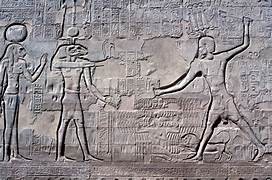
Malek, Jaromir. 2003. CE970 Antifex
Finally, there is the image of Caligula found in the eastern province of Koula in Lydia. He is shown aiming a spear at the personified Germanica on his reared up horse. Davenport claims that evidence of poor carving and rough inscriptions indicates that this monument was not the product of imperial sponsorship. Thus, we see an admiration of Rome by an eastern province of Caligula’s campaign in Germany was arguably a disaster. Tacticus reflects on Caligula’s invasion as ill-planned and embarrassing, Tacticus stated that ‘the enormous threats of Gaius Caesar were turned into farce.’ Thus, it seems odd that Koula would choose to use this humiliating incident as a source of admiration. However, the image of Caligula as a military figure is consistent with Roman iconography, namely the visual depiction of brutal subjugation of barbarians helpless in the face of Rome’s might. However, the poor quality of the imagery and poor proportioned figure communicates to the viewer that the Lydians were either unable or unwilling to comply with the Roman artistic style.
While Romans considered themselves superior this did not mean that they disregarded other cultures entirely. However, it appears the was a linear correlation between Roman writers’ respect for an occupied province and said province’s similarity/assimilation to Roman culture. This mentality is further reflected in Virgil’s Aeneid. Dido, the queen, is the personified representation of Carthage (and possibly Phoenicia) is primarily depicted positively by Virgil as a welcoming and sophisticated ruler. However, it is possible this admiration stemmed from the similarities between Carthage and Rome. Firstly, the initial meeting between Dido and Aeneas takes place in the temple of Juno with friezes depicting scenes from the Trojan war. This setting combined with Dido’s compliance with the wishes of the God Mercury demonstrate that the Carthaginians followed the Roman religion. Thus, Dido’s inevitable transformation from queen to fury could be attributed not to Carthage itself but possibly because of her sex. With the recent demise of Cleopatra, Virgil was incentivized to write a queen who did not successfully ruled long-term. Another piece of work which supports this theory is Strabo’s Geography. Specifically, Starbo draws clear distinctions between the north and southern Gauls. Woolf argues that Romans held greater respect for the southern Gaul’s who Rome had ‘civilised’ unlike their northern counterparts. In book 2 of Strabo’s Geography, he briefly mentions the ‘far famed’ Gallic city of Marseilles. Later (book 4) Strabo expands on this description, detailing the city’s topography and design, and applauding their social structure which Strabo appear to partially attribute to the city’s amity with Rome. This point is emphasized by Strabo’s claim that ‘barbarians, now that they are under the dominion of the Romans, become daily more civilized…..leaving the occupation of war.’ Here, Strabo is explicitly stating that Rome’s influence contributed to southern Gaul’s success. Strabo’s absence of information regarding the northern Gaul’s speaks louder than any description. This clear disinterest in northern Gaul is evident through Starbo’s lack of information and description of the area. Sallust’s tale of Hiempsal’s myth disregards African culture and argues that they only thrived under Roman rule. Specifically, Sallust claims that ‘Africa was … (full of) uncivilized folk… governed neither by institutions… and aimless drifters.[3] Sallust clearly perceives Africans as undisciplined and divided, thereby epitomizing a fractured barbarians society. Sallust depicts the legendary African king Jugurtha character as murderous, selfish and capable of committing bribery. Conversely, within this myth Hercules is posed as the unifying figure who established a civilised society and whose death ensued chaos. The Romans’ adoption of Heracles and extensive worship of his virtue and strength is worth noting. In fact, Augustus claimed to be a direct descendent of Hercules to further support his claim to the throne. Thus, Heracles in this narrative could serve as a symbolic figure in this myth, representing Rome’s ability to maintain order and unity. Thus, these writing of occupied Roman provinces reflected the elitest mentality of the roman aristocrats, in which there was a prevailing opinion that foreign provinces benefitted from Rome’s domination.

Conclusion
In conclusion, the ‘barbarian’ was a quintessential part of Roman culture. This symbolic uncivilised figure served as the counterpart to Rome’s united, orderly and virtuous society. Additionally, despite initial resistance, many of these eastern provinces assimilated, to some extent, to the Roman way. Their receptiveness, or at least tolerance for Roman rulers, was reflected in their art and iconography though often interpreted relative to their own ethic and religious identitys. Finally, the view of these ‘barbarians’ wasn’t entirely negative, and some historians even praised foreign provinces, specifically, those who cultural aspects were reminiscent of Rome itself.
Bibliography
Ancient Works
Augustus from Prima Porta. ca 1CE. [white marble]. At Vatican Museum: Braccio Nuovo. Ca.2290
Figure of a Roman soldier subduing an armed warrior. ca. 118-134. [terracotta]. At: British Museum: Greek & Roman. 1983,0723.1
Sallust (trans J. C. Rolfe). 2013. The War with Catiline. The War with Jugurtha. Loeb Classical Library 116. Cambridge, MA: Harvard University Press.
Strabo (trans H. L. Jones).1924. The Geography of Strabo. Cambridge, Mass.: Harvard University Press; London: William Heinemann, Ltd.
Modern Works
Ahl, F.M. 1976. Lucan: An Introduction, Ithaca and London: Cornell University Press.
Almagor, E. 2005. ‘Who is a barbarian? The barbarians in the ethnological and cultural taxonomies of Strabo’, in D. Dueck, H. Lindsay, and S. Pothecary (eds.) Strabo’s Cultural Geography: The Making of a Kolossourgia. Cambridge: Cambridge University Press, pp. 42–55.
Davenport C. 2020. ‘Roman Emperors, Conquest, and Violence’: Images from the Eastern Provinces. In: Russell A, Hellström M, eds. The Social Dynamics of Roman Imperial Imagery. Cambridge University Press: 100-127
Gruen, E. 2010. ‘Punica Fides’, Rethinking the Other in Antiquity, Princeton: Princeton University Press 220-245
Hardie, P. R. 2014. The last Trojan hero : a cultural history of Virgil’s Aeneid (1st ed.). I.B. Tauris.
Hussaini, I.U.2024. ‘ART AND ARCHITECTURE AS SUSTAINABLE TOOLS OF PROPAGANDA: A BRIEF REVIEW OF THE IMPERIAL ROME AND ITS INFLUENCES ON THE 21ST CENTURY POLITY.” Journal of Art and Architecture Studies.
Kehoe DP.2005. Roman Law in Africa. The Classical Review; 55(1):284-285. doi:10.1093/clrevj/bni157
Mathisen, Ralph W. 2006.’Peregrini, barbari, and cives Romani: Concepts of citizenship and the legal identity of barbarians in the later Roman Empire.’ The American Historical Review 111.4: 1011-1040.
Schneider, Rolf Michael. 1996. ‘The barbarian in Roman art: A countermodel of Roman identity.’ 19-30.
Smith, Hailey. 2024. ‘Cultural Imperialism in the Roman Empire: a Give and Take Relationship between Imperial Rome and Provincial/External Cultures.’ Venture: The University of Mississippi Undergraduate Research Journal 6.1: 11.
Weidemann, T. 1993. ‘Sallust’s Jugurtha: Concord, Discord, and Digressions‘, Greece and Rome’ 40, 48-57.
 Siobhan ANCH3570 website